
How Compound Interest Actually Works: The Complete Guide to Growing Your Savings
The Unseen Force of Wealth Accumulation
Most financial advice focuses on earning more or spending less.
While both matter, neither explains how modest, consistent savings can transform into meaningful long-term financial security.
The underlying mechanism behind long-term capital growth is compound interest.
It is not a secret shortcut, a quick hack, or a guaranteed path to wealth.
Instead, compound interest is a mathematical process where earnings generate their own earnings over time.
When you earn interest on a deposit, that interest is added to your principal balance.
In the next period, interest is calculated on both the original principal and the interest previously added.
This creates a compounding loop that accelerates as time progresses.
Understanding this mechanism allows you to make informed decisions about saving, investing, and debt management.
Simple Interest vs. Compound Interest: The Fundamental Difference
To understand compound interest, it helps to contrast it with simple interest.
Simple interest is calculated solely on the original principal amount for the entire duration of the asset or loan.
If you deposit $10,000 at a 5% simple annual interest rate, you earn $500 every year.
After 10 years, you have earned $5,000 in interest, bringing your total balance to $15,000.
The annual growth remains flat because the interest earned in prior years sits idle without generating additional return.
Compound interest operates differently by reinvesting the earned interest back into the principal.
Using the same $10,000 at a 5% annual rate compounded annually, the first year yields $500, bringing your balance to $10,500.
In the second year, the 5% calculation applies to $10,500 rather than $10,000.
Your second-year interest earned is $525, bringing your total to $11,025.
By year 10, the balance grows to $16,288.95.
By year 30, simple interest yields a total of $25,000, while compound interest yields $43,219.42.
The initial deposit is identical, and the rate is identical, yet the ultimate output differs dramatically.
Comparing Simple vs. Compound Growth ($10,000 at 5% Annual Interest)
| Year | Simple Interest Balance | Compound Interest Balance | Difference |
|---|---|---|---|
| Year 1 | $10,500.00 | $10,500.00 | $0.00 |
| Year 5 | $12,500.00 | $12,762.82 | +$262.82 |
| Year 10 | $15,000.00 | $16,288.95 | +$1,288.95 |
| Year 20 | $20,000.00 | $26,532.98 | +$6,532.98 |
| Year 30 | $25,000.00 | $43,219.42 | +$18,219.42 |
Key Takeaways
- Simple interest pays returns strictly on the initial principal balance.
- Compound interest pays returns on both the principal and all accumulated earnings.
- The growth trajectory of compounding is non-linear and accelerates over longer time horizons.
The Mechanics of Compounding: Mathematical Structure and Frequency
The mathematical equation for compound interest illustrates how variables interact over time.
The standard formula is written as: A = P (1 + r/n)^(nt)
Where A represents the final balance, P is the initial principal, r is the annual nominal interest rate, n is the compounding frequency per year, and t is the time in years.
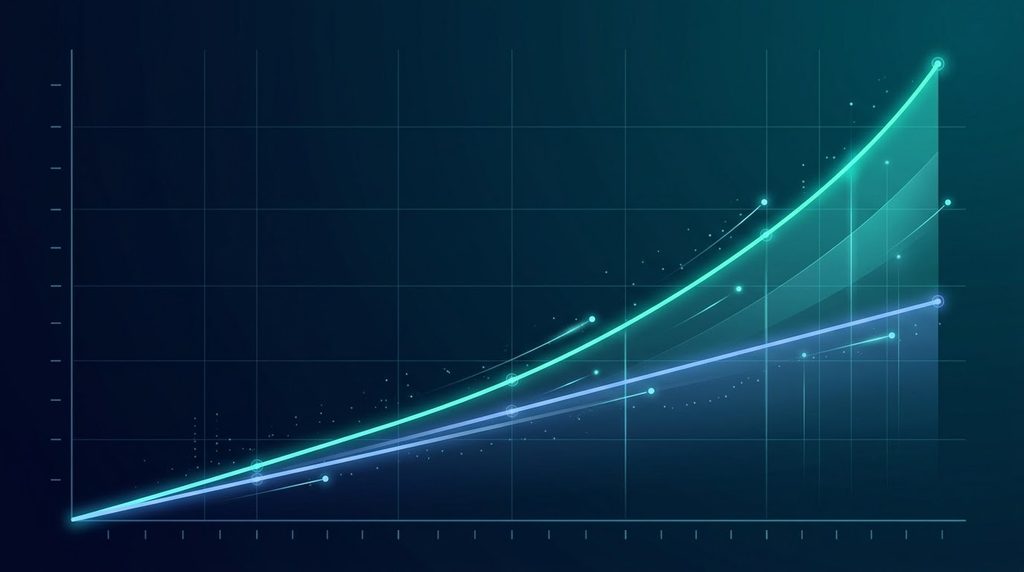
Compounding frequency determines how often interest is calculated and added back to the account balance.
Common frequencies include annual, quarterly, monthly, and daily compounding.
The higher the compounding frequency, the faster the balance grows, though the marginal difference diminishes as frequency increases.
For instance, $10,000 invested at 6% nominal annual rate for 20 years results in different totals depending on frequency:
Annual compounding (n=1) yields $32,071.35.
Monthly compounding (n=12) yields $33,102.04.
Daily compounding (n=365) yields $33,197.62.
The difference between annual and daily compounding over 20 years in this example is $1,126.27.
Understanding this mechanics helps evaluate savings products like High-Yield Savings Accounts (HYSAs) or Certificates of Deposit (CDs).
Financial institutions are required in the United States to state the Annual Percentage Yield (APY).
APY reflects the true annual return taking into account the effect of compounding frequency, allowing for direct comparison across accounts.
In Short
- Compounding frequency determines how often interest turns into new principal.
- More frequent compounding yields higher final returns, though returns plateau at higher frequencies.
- APY provides an standardized metric that accounts for compounding frequency automatically.
The Four Core Drivers of Compounded Returns
Four primary factors dictate the speed and magnitude of compounding.
Controlling these variables allows savers to align their financial habits with their long-term objectives.
1. Time Horizon
Time is the single most powerful amplifier of compound interest.
Because compounding growth is exponential, the vast majority of total gains occur in the final years of a multi-decade timeline.
Consider two individuals, Person A and Person B, both earning a constant 6% average annual return.
Person A invests $300 a month starting at age 25 and stops contributing at age 35 (10 years of contributions totaling $36,000).
Person A then leaves the money untouched until age 65 without adding another dollar.
Person B waits and begins investing $300 a month at age 35, contributing continuously until age 65 (30 years of contributions totaling $108,000).
At age 65, Person A has accumulated approximately $315,000 despite putting in only $36,000.
Person B has accumulated approximately $301,000 despite contributing three times as much money over 30 years.
Person A won because their initial principal had an additional 10 years to compound untouched.
2. Rate of Return
The annual percentage rate acts as the compounding multiplier.
Small changes in return rates result in substantial long-term differences.
A $10,000 investment over 30 years at 4% grows to approximately $32,434.
At 8%, that same $10,000 grows to approximately $100,626.
Doubling the rate of return more than triples the final accumulated balance due to non-linear compounding math.
However, pursuing higher returns invariably requires accepting higher financial risk or asset volatility.
3. Regular Capital Contributions
While an initial deposit grows over time, adding periodic contributions drastically changes the growth trajectory.
Adding $250 each month to a $10,000 initial balance at a 6% return over 25 years yields $216,337.
Without monthly contributions, the $10,000 alone grows to $42,918 over the same period.
Regular contributions continuously raise the baseline principal, feeding larger absolute amounts into the compounding loop.
4. Cost Drag and Fee Reduction
Fees act as negative compounding.
Just as gains compound positively, annual management fees or expense ratios compound negatively against your total asset base.
An account balance of $100,000 earning a 7% gross annual return over 30 years would grow to roughly $761,225 with zero fees.
If that portfolio carries a 1.00% annual fee (net return 6%), the final balance shrinks to $574,349.
The 1.00% fee cost the investor over $186,000 in direct losses and lost compounding potential.
The Rule of 72: Mental Math for Estimating Growth
The Rule of 72 is a practical mental calculation used to estimate how many years it takes for an investment to double at a given annual rate of return.
To use the rule, divide 72 by the expected fixed annual interest rate.
The result is the approximate number of years required for your money to double.
Rule of 72 Formula Examples
- At a 3% interest rate (e.g., standard high-yield account): 72 / 3 = 24 years to double.
- At a 6% interest rate (conservative balanced portfolio): 72 / 6 = 12 years to double.
- At an 8% interest rate (long-term equity historical average): 72 / 8 = 9 years to double.
- At a 12% interest rate (high-yield unsecured debt): 72 / 12 = 6 years for debt to double.
The Rule of 72 is an approximation that works best for annual return rates between 4% and 12%.
It also serves as a warning regarding high-interest debt, where compounding works aggressively against the borrower.
Practical Financial Tool: Conservative Compounding Framework
Below is a copy-paste framework to help you map out realistic, conservative savings goals over multi-year horizons.
This framework uses conservative assumptions to avoid overestimating future returns.
Step-by-Step Compounding Calculation Sheet
Use the following inputs to calculate your baseline expectation:
- Baseline Principal (P): Current liquid capital reserved for long-term growth.
- Monthly Addition (PMT): Realistic monthly amount you can save consistently without touching.
- Conservative Return Assumption (r): Use 3-4% for cash-equivalent reserves; use 5-6% for conservative diversified portfolios (adjusted for potential long-term inflation).
- Timeframe (t): Target duration in years (minimum 5-10 years recommended).
| Year Horizon | Assumed Nominal Rate | Starting Capital | Monthly Contribution | Estimated Total Value |
|---|---|---|---|---|
| 5 Years | 5.0% | $5,000 | $200 | $19,890 |
| 10 Years | 5.0% | $5,000 | $200 | $38,963 |
| 15 Years | 5.0% | $5,000 | $200 | $63,382 |
| 20 Years | 5.0% | $5,000 | $200 | $94,646 |
| 25 Years | 5.0% | $5,000 | $200 | $134,672 |
Note: Figures are conservative projections for illustrative and educational purposes. They do not account for taxes or transaction costs.
Step-by-Step Money-Saving & Investing Guide: Harnessing Compounding Without High Risk
To benefit from compound growth without taking unnecessary risks, follow this structured four-step process.
Step 1: Eliminate High-Interest Consumer Debt
Before attempting to compound savings, address high-interest debt such as credit cards or personal loans.
Credit card interest rates often exceed 18% to 24% annually, compounding daily.
No standard low-risk investment can reliably outperform an 18% guaranteed loss from debt interest.
Paying off high-interest debt offers a risk-free return equal to the interest rate avoided.
Step 2: Build a High-Yield Liquid Emergency Buffer
Establish a 3-to-6-month emergency cash cushion in a FDIC-insured High-Yield Savings Account.
This ensures you will never be forced to sell compounding investments prematurely during financial shocks or market downturns.
Ensure the account compounds daily or monthly and carries no account maintenance fees.
Step 3: Establish Automated Low-Cost Contributions
Manual saving relies on willpower, which often fails over multi-year horizons.
Automate monthly transfers from your checking account into your designated investment or savings account immediately after paydays.
Prioritize low-cost index funds or ETFs with expense ratios under 0.10% if investing long-term.
Step 4: Audit Fees and Tax-Advantaged Shelters Annually
Review your investment structures once per year to minimize tax drag and account expenses.
Utilize tax-sheltered accounts like Traditional IRAs, Roth IRAs, or 401(k)s where appropriate.
Reducing administrative drag preserves thousands of dollars in compounding potential over decades.
Bottom Line
- Eliminate debt compounding against you before building assets.
- Protect your core assets with automated contributions and dedicated cash reserves.
- Keep administrative fees extremely low to retain maximum long-term gains.
Common Misunderstandings and Pitfalls of Compounding
While the mathematics of compound interest are clear, real-world execution encounters psychological and economic friction.
1. The Invisible Impact of Inflation
Calculating nominal returns without accounting for inflation creates a false sense of security.
If your account yields 4% annually but inflation averages 3%, your real purchasing power growth is approximately 1%.
Long-term wealth building requires strategies that outperform annual purchasing power erosion.
2. Expecting Linear Progress in Volatile Markets
In market-based compounding (like equities), returns are not paid in steady annual percentages.
One year may yield +15%, the next year -8%, followed by +2%.
Compounding in volatile assets relies on long-term compound annual growth rates (CAGR), not fixed annual payments.
Investors who panic and exit during down years break the compounding chain, locking in losses.
3. The Temptation to Interrupt Compounding
Charlie Munger famously noted that the first rule of compounding is to never interrupt it unnecessarily.
Withdrawing principal or gains early resets the exponential curve back to lower levels.
Even small withdrawals significantly alter the final output decades later.
Tax Efficiency: Protecting Your Compounding Chain
Taxes act as an annual friction point on compound growth.
In a standard taxable brokerage account, dividends, realized capital gains, and interest payments are taxed annually.
This annual tax drag reduces the total balance left inside the account to compound in subsequent years.
Tax-Deferred vs. Tax-Free Structures
Using tax-advantaged accounts allows capital to compound without annual tax friction:
- Tax-Deferred Accounts (e.g., Traditional IRA, 401k): Contributions may reduce taxable income today, and assets grow without annual taxation. Taxes are paid upon withdrawal in retirement.
- Tax-Free Growth Accounts (e.g., Roth IRA, Roth 401k): Contributions are made with post-tax income, but all future growth and qualified withdrawals are entirely tax-free.
- Taxable Brokerage Accounts: Offer full liquidity without contribution limits or withdrawal penalties, but incur ongoing tax drag on dividends and capital gains.
Quick Summary
- Annual taxation reduces the capital remaining in your account to compound.
- Tax-advantaged vehicles like Roth or Traditional IRAs eliminate or delay tax drag.
- Choose accounts based on your short-term liquidity needs versus long-term growth goals.
Anticipated Reader Objections & Realistic Limits
What if I can only afford to save $50 a month?
Small amounts matter immensely due to habit formation and the time horizon.
$50 a month invested at a 6% return yields roughly $50,200 over 30 years.
The principal contributed is $18,000; the remaining $32,200 is purely compound growth.
Is compound interest guaranteed?
Compound interest itself is a mathematical formula, not a financial guarantee.
In fixed-income products like CDs or high-yield savings accounts, returns are predictable up to guaranteed rate terms.
In market investments, average returns fluctuate, and capital is subject to market risk.
What if I am starting late in life?
If your time horizon is shorter, you cannot rely as heavily on decades of exponential time compounding.
In this scenario, savings rate (the absolute dollars contributed) and risk mitigation become far more important than pursuing speculative yields.