
Print on Demand for Passive Income: Complete Guide for 2026

Print on demand passive income 2026 has become one of the most searched side-income topics — and for understandable reasons. The model lets you upload original designs to a platform, and when a customer buys a product, the platform handles printing, packaging, and shipping at no upfront cost to you. You never manage inventory, process orders manually, or risk money on stock that doesn’t sell.
But “passive” needs context here. Building a store that earns consistently requires a real investment of time upfront — typically months of designing, listing, and refining. This guide explains exactly what that looks like, which platforms deserve your attention, and what honest earning expectations look like before you commit.
Start Selling Designs on Printify — Free Plan Available
Printify connects your Etsy or Shopify store to 900+ products. No inventory, no minimum orders. Your first listing can go live today.
Start Free on PrintifyWe may earn a commission at no extra cost to you.
Print on Demand: What This Guide Covers (and What It Doesn’t)
This guide focuses on one question: can print on demand realistically become a passive income source in 2026? It covers how to evaluate platforms, what factors determine whether a store earns reliably, and who is best positioned to succeed with this model.
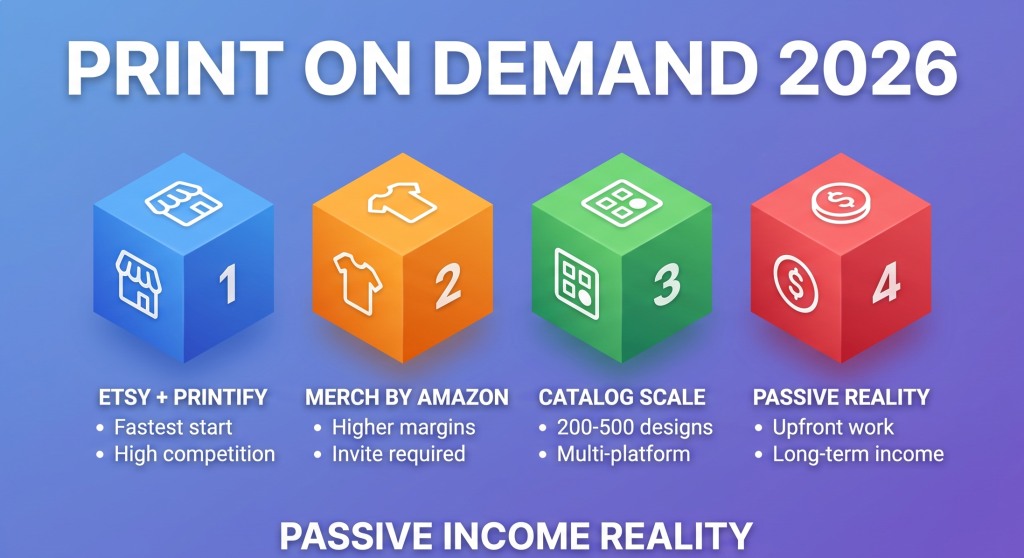
- Print on demand becomes genuinely passive after your catalog is built — the upfront design work is the real investment.
- Etsy + Printify is the fastest path to a first sale; Merch by Amazon has higher margins but requires an invitation.
- Consistent $100/day from POD typically requires 200-500 designs across multiple products and platforms.
This is not a design tutorial, a platform setup walkthrough, or a catalog comparison of every POD supplier. If you need step-by-step Canva instructions or a product-quality breakdown by supplier, those are separate topics. The goal here is to help you decide whether this model fits your situation — before you invest weeks of work finding out the hard way.
How to Evaluate Print on Demand Passive Income Potential in 2026
Not every POD store becomes passive. Whether yours does depends on a few factors worth understanding before you upload your first design.
Design Volume
Most experienced sellers report that consistent income arrives after 50 to 200 or more active listings. The passive phase — where existing designs earn without ongoing work — only follows after building that library. Treating early uploads as long-term assets rather than quick wins changes how you pace the work.
Niche Specificity
Broad designs compete against millions of listings on every major platform. Designs built for a specific hobby, profession, or community find buyers more reliably because search intent is clearer and competition is lower. A narrower focus also means fewer listings are needed to see results.
Profit Margin Reality
Margins on print on demand are thin. On a $22 t-shirt, your net royalty after platform fees and production costs typically falls between $3 and $6. Reaching meaningful monthly income requires high sales volume. That math is worth working through for your target income number before you start designing.
Design for search, not aesthetics. Use the Etsy search bar to find phrases buyers actually type (e.g., ‘funny nurse gift’) and build designs around those exact phrases.
Quick Summary
- Passive income from POD typically arrives after 50–200+ active listings
- Niche-specific designs outperform broad, generic art in search results
- Net margins of $3–$6 per unit mean volume is the only path to meaningful income
Platform Comparison: Where to Start
Three platforms are worth evaluating seriously for beginners in 2026. Each involves a different tradeoff between access, control, and earning potential.
Merch by Amazon
Merch by Amazon gives you access to Amazon’s buyer traffic without running paid ads. Listings stay live indefinitely, and you earn royalties per sale. The drawback is that access requires an application, and approval timelines vary. For sellers who get in, the organic traffic advantage is real — though royalty rates per unit are modest.
Etsy + Printful or Printify
This combination gives you more control over pricing, branding, and how your store presents itself. Etsy charges listing fees and takes a revenue cut, so margins are narrower than they appear. You’ll also need to manage SEO — titles, tags, and thumbnails — actively in the early months. In return, you own the customer relationship and can build a recognizable storefront over time.
Redbubble and Teepublic
These platforms handle everything — product creation, traffic, fulfillment, and customer service. You upload designs and earn a percentage per sale. Income per unit is lower, and you have no control over platform changes or pricing. They’re useful for testing designs quickly, but building significant passive income on Redbubble alone is a slower path than most tutorials acknowledge.
Key Takeaways
- Merch by Amazon offers the most organic traffic but requires application approval
- Etsy + Printful gives more brand control at the cost of more active management
- Redbubble is the simplest entry point but generates lower earnings per sale
- No single platform eliminates the need for consistent, original design output
Who This Is (and Isn’t) For
Print on demand works best for people with original design skills who can produce work consistently without hiring outside help. It also suits people willing to approach it as a multi-month project — not a quick income source. If you enjoy the design process, the early work is building an asset rather than grinding through tasks.
POD platforms own the customer relationship. If Merch by Amazon suspends your account or Etsy changes its algorithm, your income can drop to zero overnight. Diversify across at least two platforms.
It’s not a good fit if you need income within the next 30 to 60 days. Most new POD sellers earn little to nothing in the first few months. It’s also less suitable if you plan to outsource all design work — margins are too thin to absorb significant design costs without high sales volume to offset them.
People with an existing audience — social media followers, email subscribers, or a niche community — have a meaningful head start. Traffic is the hardest variable in print on demand, and an audience reduces that problem substantially from day one.
In Short
- Best suited for creatives who design independently and can work consistently over months
- Not a good fit if you need fast income or plan to rely heavily on outsourced designs
- An existing audience significantly shortens the time to first meaningful earnings
Risks and Limits to Understand First
Intellectual property violations are the most serious operational risk for new sellers. Uploading designs that reference copyrighted characters, brand logos, or trademarked phrases — even loosely — can result in account suspension. Platforms enforce IP claims quickly, and reinstatement is not guaranteed. Building your store entirely on original work is not just the ethical choice — it’s the only stable long-term strategy.
Platform dependency is worth naming directly. Your income relies on policies, algorithm updates, and fee structures that you don’t control — all of which have shifted in recent years for Etsy, Amazon, and Redbubble. Sellers who rely entirely on one platform carry meaningful concentration risk.
Tax obligations apply from your first sale. POD income is taxable self-employment income in the U.S. Platforms issue 1099 forms above certain thresholds, but you’re responsible for reporting all income regardless of whether a form arrives. Tracking sales and setting aside a portion for taxes is a basic discipline that new sellers often skip until it becomes a problem.
Bottom Line
- IP violations are the fastest path to account closure — original designs only
- Single-platform dependency creates income risk when policies change
- POD income is taxable from dollar one — track it and plan accordingly
Is Print on Demand Passive Income Worth It in 2026?
Print on demand passive income 2026 is genuinely achievable — but the timeline is longer than most tutorials suggest. Stores that generate reliable recurring income typically have 100 or more active listings, have survived at least one platform change, and target specific niches rather than broad appeal. Those conditions take months to build, not weeks.
The strongest case for starting: upfront costs are minimal if you design your own work, and a listing uploaded today can still earn two years from now without additional effort. The compounding value of a growing catalog is the real passive income mechanism — not any single product.
The strongest case against: if you can’t commit to consistent design output over several months, the passive phase never arrives. This model front-loads effort and back-loads reward. That timeline doesn’t fit every situation.
Print on demand is worth pursuing if you have original design skills, low income urgency, and the patience to build a catalog steadily. It’s worth passing on if any of those three conditions don’t apply right now.
Print on demand won’t replace a salary quickly. But for creatives with original designs and a long enough horizon, it can become a genuinely low-maintenance income stream. Treat the first six months as an investment of creative time rather than a source of income, and the long-term math works in your favor.
Useful Resources for Print on Demand Sellers
These references are worth consulting before you commit to a platform or file your first tax return. The IRS self-employment tax overview explains what you owe from your first POD sale. Printify’s print on demand guide keeps production cost and margin data current as supplier pricing shifts. For formalizing your business, the SBA business registration guide walks through the steps without unnecessary complexity. If you promote your designs through social media or paid partnerships, review the FTC endorsement and advertising disclosure guidance to understand what disclosures are legally required.
Related Reading

