
Should You Consolidate Your Student Loans? Decision Factors and Trade-Offs

Is Student Loan Consolidation Right for You?
Managing multiple student loan payments each month can feel overwhelming. Between varying interest rates, separate loan servicers, and mismatched due dates, it is easy to see why simplifying everything into one single payment sounds deeply appealing.
However, bundling your student loans together is not an automatic win. Depending on whether your debt is federal or private, consolidation can either save you money or lock you out of crucial consumer protections.
Federal Consolidation vs. Private Refinancing: The Critical Distinction
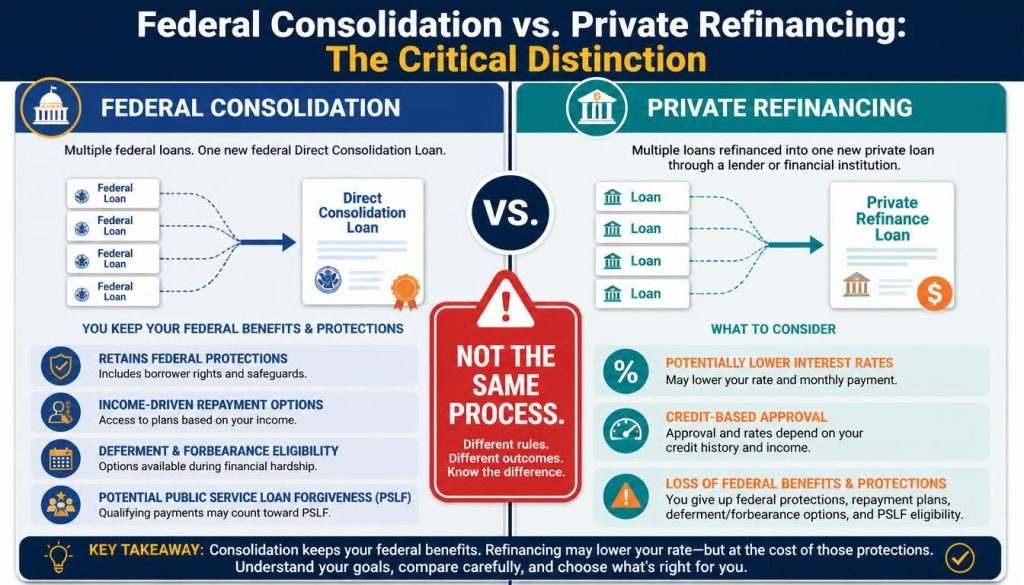
Before taking any action, it is essential to understand that the financial industry uses two terms that sound similar but operate very differently: Direct Loan Consolidation and Private Refinancing.
Federal Direct Loan Consolidation combines multiple federal student loans into a single federal loan through the U.S. Department of Education. Crucially, this process does not lower your interest rate. Instead, your new rate is calculated as a weighted average of your existing rates, rounded up to the nearest one-eighth of one percent.
Private Refinancing involves taking out an entirely new loan with a private lender—such as a bank or credit union—to pay off existing federal or private loans. This is the only path that can potentially secure a lower interest rate, but refinancing federal debt permanently converts it into private debt.
In Short
- Federal consolidation simplifies payments and preserves federal benefits, but it does not reduce your interest rate.
- Private refinancing can lower interest rates for borrowers with strong credit, but it permanently strips away federal safety nets.
4 Key Decision Factors to Evaluate Before Proceeding
To figure out whether student loan consolidation is worth it for your personal financial situation, evaluate these four core factors.
1. Your Current Interest Rates and Credit Profile
If you hold private loans with high variable interest rates and your credit score or income has improved significantly since you originally applied, refinancing through a private lender can yield substantial interest savings over time.
Conversely, if your debt consists mostly of fixed-rate federal loans, consolidating them federally will not save you money on interest costs.
2. Need for Lower Monthly Payments vs. Total Long-Term Cost
Federal consolidation allows you to extend your repayment term up to 30 years. This significantly lowers your required monthly payment, providing immediate cash-flow relief for tight budgets.
The trade-off is total cost. Extending your repayment timeline means accruing interest over a much longer period, which can add thousands of dollars to the total cost of your education.
3. Reliance on Federal Safety Nets
Federal loans come with built-in protections, including Income-Driven Repayment (IDR) plans, loan forgiveness options like Public Service Loan Forgiveness (PSLF), and generous deferment or forbearance provisions during financial hardship.
If you refinance federal loans into a private student loan, you lose access to all federal repayment flexible plans and forgiveness programs forever.
4. Number of Loan Servicers
If you are struggling simply to keep track of four or five different monthly payments to different debt management portals, federal consolidation stream-lines those into one clean invoice without sacrificing safety nets.
Bottom Line
- Extend your loan term only if immediate monthly cash flow is a critical priority, keeping in mind it increases overall interest costs.
- Never refinance federal loans into private debt if you might ever need income-driven repayment or public service forgiveness.
The Hidden Risks of Refinancing Federal Debt
The single biggest mistake borrowers make is trading federal consumer protection for a minor interest rate reduction from a private lender. During periods of job loss, medical emergencies, or broader economic downturns, federal safeguards provide vital relief.
Private lenders typically offer very limited hardship options. If you experience a sudden drop in earnings, private institutions are generally under no obligation to adjust your monthly payments based on your income.
Key Takeaways
- Federal safety nets act as mandatory insurance against career or health disruptions.
- Private refinancing is best suited for borrowers with highly stable income, strong emergency savings, and existing private loans.
Practical Decision Framework: Should You Consolidate?
Use this decision checklist to determine your best path forward:
- Keep Federal Loans Separate If: You are pursuing PSLF, currently enrolled in an IDR plan, or work in qualifying public service roles.
- Use Federal Direct Consolidation If: You hold older federal loan types (like FFEL or Perkins loans) and want to qualify for modern federal plans, or want single-payment simplicity without losing federal perks.
- Consider Private Refinancing If: You hold high-interest private student loans, maintain a strong credit profile, have stable earnings, and do not rely on federal hardship protections.
Step-by-Step Consolidation & Refinancing Assessment Guide
- Inventory Your Debt: Log into StudentAid.gov to list all federal loans, interest rates, and loan types. Gather statements for any private loans.
- Determine Your Financial Goal: Decide whether your primary objective is lowering monthly payment obligations, reducing total interest costs, or simplifying bill management.
- Test Hardship Scenarios: Ask yourself: ‘If my household income dropped by 30% tomorrow, could I comfortably maintain private loan payments without federal income-driven safeguards?’
- Compare Soft Pre-Qualifications: If exploring private refinancing for private debt, request pre-qualification quotes using soft credit pulls that do not impact your credit score.
- Execute or Reassess: Complete your Direct Consolidation application at StudentAid.gov for federal loans, or finalize private refinancing for high-rate private debt. Re-evaluate annually.