
Do You Need a Financial Advisor, or Can You DIY Your Investments?


The Essential DIY vs. Advisor Decision
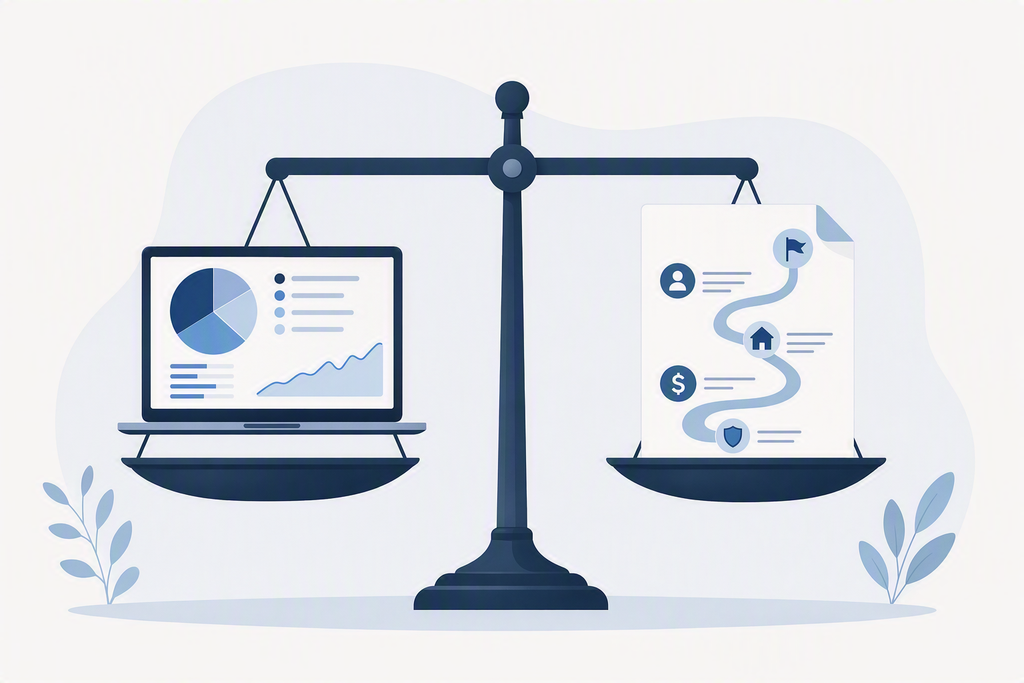
Managing your money used to require a professional intermediary with access to proprietary market tools. Today, low-cost broad-market index funds, automated brokerages, and transparent tax software allow anyone to build and maintain a sophisticated long-term portfolio independently.
Yet the wealth management industry continues to grow. Choosing whether to hire a financial advisor or handle investments yourself isn’t a badge of honor or a intelligence test. It is a practical business decision based on three primary variables: structural financial complexity, available time and personal interest, and total cost relative to assets managed.
For most straightforward financial paths—such as accumulating wealth through a W-2 salary using broad index funds—self-management is straightforward, effective, and significantly cheaper over time. However, complex life events or severe behavioral discipline hurdles can change that equation.
Key Takeaways
- Self-directed investing with low-cost index funds is suitable for straightforward wealth building during the accumulation phase.
- Hiring an advisor makes sense primarily when managing complex taxes, estate structures, or behavioral discipline during market crashes.
- A standard 1% annual advisory fee compound significantly over decades, reducing total long-term portfolio growth.
3 Core Factors to Determine Your Need
To determine if you need professional guidance or can confidently self-manage, evaluate your situation across three distinct criteria.
1. Financial Complexity and Structural Nuance
If your financial life consists of a primary salary, a standard 401(k), an IRA, and a personal brokerage account, your needs are minimal. The core rules of asset allocation, automated contribution, and annual rebalancing can be learned in a single afternoon.
Complexity increases sharply when non-standard financial variables enter the picture:
- – Stock options, RSUs, or concentrated equity holdings from an employer
- – Ownership of small businesses or multi-state real estate investments
- – Intricate estate planning needs, special needs trusts, or complex blended family inheritances
- – Multi-source retirement drawdown plans requiring specialized tax sequence optimization
When these factors exist, a qualified fee-only Certified Financial Planner (CFP) often provides value that far exceeds investment selection alone through tax and structural risk mitigation.
2. Time Commitment, Interest, and Behavioral Discipline
Managing a portfolio requires very little time—often less than two hours per year once an automated system is set up. However, it requires significant interest to learn basic principles and absolute behavioral discipline during extreme market downturns.
The biggest threat to a self-directed investor’s long-term return isn’t market volatility; it is panic selling during market drops. If you suspect you will panic when your portfolio drops 30% or if you completely lack interest in checking account health once or twice a year, paying a professional to act as a behavioral buffer can prevent catastrophic mistakes.
3. Asset Size vs. Fee Impact
Advisors generally charge in one of three ways: an Assets Under Management (AUM) fee (typically 1% annually), flat hourly or project fees, or an annual retainer. Understanding how fees impact long-term compounding is vital.
A 1% annual fee sounds small, but over a 30-year period, that single percentage point can absorb roughly 20% to 25% of your potential long-term portfolio value due to lost compounding power. For a $500,000 portfolio, a 1% fee equals $5,000 every single year. For simple allocation needs, that money is far better off remaining invested in low-cost ETFs charging under 0.10% annually.
In Short
- Simple financial pictures require simple tools: high-cost advisors are rarely necessary for basic index investing.
- Behavioral management is often the real benefit of an advisor; panicking during a crash costs far more than advisory fees.
- Watch fee structures closely: flat-fee or hourly advisors are generally more cost-effective than 1% ongoing AUM fees for simple needs.
Step-by-Step Decision Framework
If you are undecided, follow this four-step evaluation to determine your immediate next action.
- Audit your balance sheet and tax sources: List all income sources, account types, and debt obligations. If everything fits on one sheet of paper without specialized tax structures, start with DIY.
- Calculate the true financial cost: Multiply your total liquid investable assets by 0.01. Ask yourself: am I receiving equivalent annual value for this dollar amount? If you have $300,000, is advice worth $3,000 every year?
- Evaluate your emotional discipline under stress: Be honest about your reaction during past market declines. Did you check prices constantly or panic? If yes, behavioral coaching may be necessary.
- Run a 12-month self-management trial: Build a simple target-risk or broad three-fund index portfolio using automated contributions. Re-evaluate after one full year. You can always hire an advisor later if complexity grows.
Bottom Line
- Audit your balance sheet first to confirm whether genuine structural complexity exists.
- A 12-month low-cost DIY trial allows you to test your willingness and discipline with zero lock-in.
- Switch to a fee-only, fiduciary planner whenever your personal situation becomes too complex or stressful to manage alone.

