
Roth IRA vs. Traditional IRA: How to Decide Which Is Better for You


Choosing between a Roth IRA and a Traditional IRA usually comes down to one simple question: do you want to pay taxes now, or pay taxes later?
Both accounts offer clear tax advantages over a standard brokerage account. However, picking the right one depends on your current income, future expectations, and need for flexibility.
This guide breaks down the four core decision factors to help you pick the account that keeps more money in your pocket. Note that this comparison focuses on direct contributions and excludes 401(k) rollover strategies or backdoor conversions.
The Core Difference: Pay Taxes Now or Later
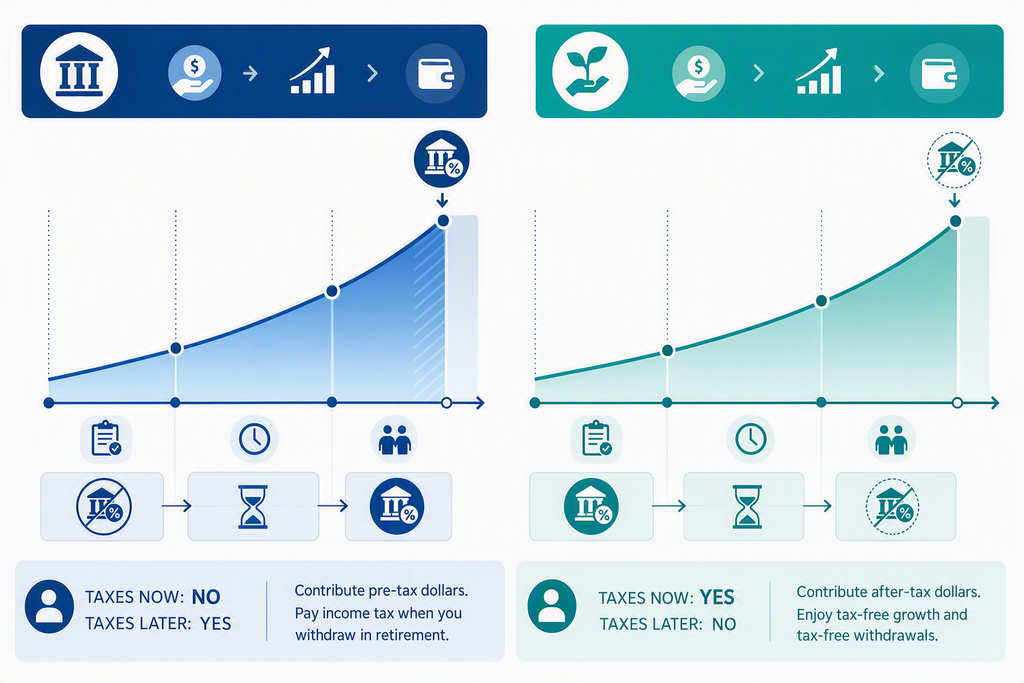
The main functional difference between a Roth IRA and a Traditional IRA lies in when the Internal Revenue Service taxes your money.
With a Traditional IRA, you contribute pre-tax or tax-deductible dollars. Your money grows tax-deferred, and you pay regular income tax when you withdraw funds in retirement.
With a Roth IRA, you contribute after-tax dollars. You get no immediate tax deduction, but your investments grow completely tax-free, and qualified withdrawals in retirement cost you zero dollars in income tax.
Key Takeaways
- Traditional IRAs provide tax savings today in exchange for taxed withdrawals tomorrow.
- Roth IRAs require full tax payment today in exchange for tax-free growth and tax-free retirement income.
- Neither account is universally better; the right choice depends on your personal financial profile.
4 Factors That Decide Which IRA Fits Your Profile
Rather than guessing, evaluate these four specific criteria to identify which option yields higher long-term value.
1. Current vs. Expected Future Tax Bracket
If you expect to be in a higher income tax bracket in retirement than you are today, a Roth IRA is generally superior. Paying tax now locks in your current lower rate.
If you are currently in your peak earning years and expect your tax rate to drop significantly during retirement, a Traditional IRA offers an immediate tax break when it matters most.
2. Income Eligibility Limits
Anyone with earned income can contribute to a Traditional IRA, though tax deductibility phases out at higher income levels if you or your spouse have access to a workplace retirement plan.
Roth IRAs have strict income caps. If your modified adjusted gross income exceeds annual federal thresholds, your direct contribution limit scales down to zero.
3. Withdrawal Flexibility Before Retirement
Roth IRAs offer unique liquidity. You can withdraw your original contributions (not earnings) at any time, for any reason, with zero taxes or early withdrawal penalties.
Traditional IRAs penalize early distributions. Taking money out before age 59½ typically triggers regular income tax plus a 10% federal penalty tax, with limited tax law exceptions.
4. Required Minimum Distributions (RMDs)
Traditional IRAs require you to start taking minimum annual withdrawals once you reach age 73 or 75, regardless of whether you need the cash.
Roth IRAs have no required minimum distributions during your lifetime. You can leave the capital untouched for as long as you live, making them powerful vehicles for estate planning.
In Short
- Choose Roth if you are early in your career or expect higher future taxes.
- Choose Traditional if you currently pay high marginal tax rates and need tax relief now.
- Choose Roth if you prioritize liquidity and dislike mandatory withdrawal rules in old age.
Step-by-Step Decision Guide
Follow these steps to choose and open the appropriate account for your goals.
- Check your Modified Adjusted Gross Income (MAGI): Confirm whether you meet the eligibility limits for direct Roth IRA contributions set by federal tax code.
- Determine your tax direction: Compare your current marginal bracket against your expected retirement income needs.
- Evaluate your emergency buffer: If your cash savings are lean, the ability to pull Roth contributions tax-free offers an extra safety cushion.
- Select your account type: Open the account with a reputable broker, select low-cost index funds, and set up automated monthly transfers.
Bottom Line
- Decision rules are straightforward: High tax rate today favors Traditional; lower tax rate today favors Roth.
- When in doubt, opening a Roth IRA early builds tax diversification that benefits most long-term savers.
- Consistently funding either account is far more critical than finding perfect tax optimization.

