
Debt Avalanche vs. Debt Snowball: Which Gets You Debt-Free Faster?
Debt Avalanche vs. Debt Snowball: The Quick Choice
Choosing a debt payoff strategy comes down to one clear tradeoff. You are choosing between mathematical speed and behavioral momentum.
The Debt Avalanche strategy focuses entirely on interest rates. You pay off high-interest debt first to minimize total interest cost.
The Debt Snowball strategy focuses entirely on account balances. You pay off small balances first to build psychological momentum.
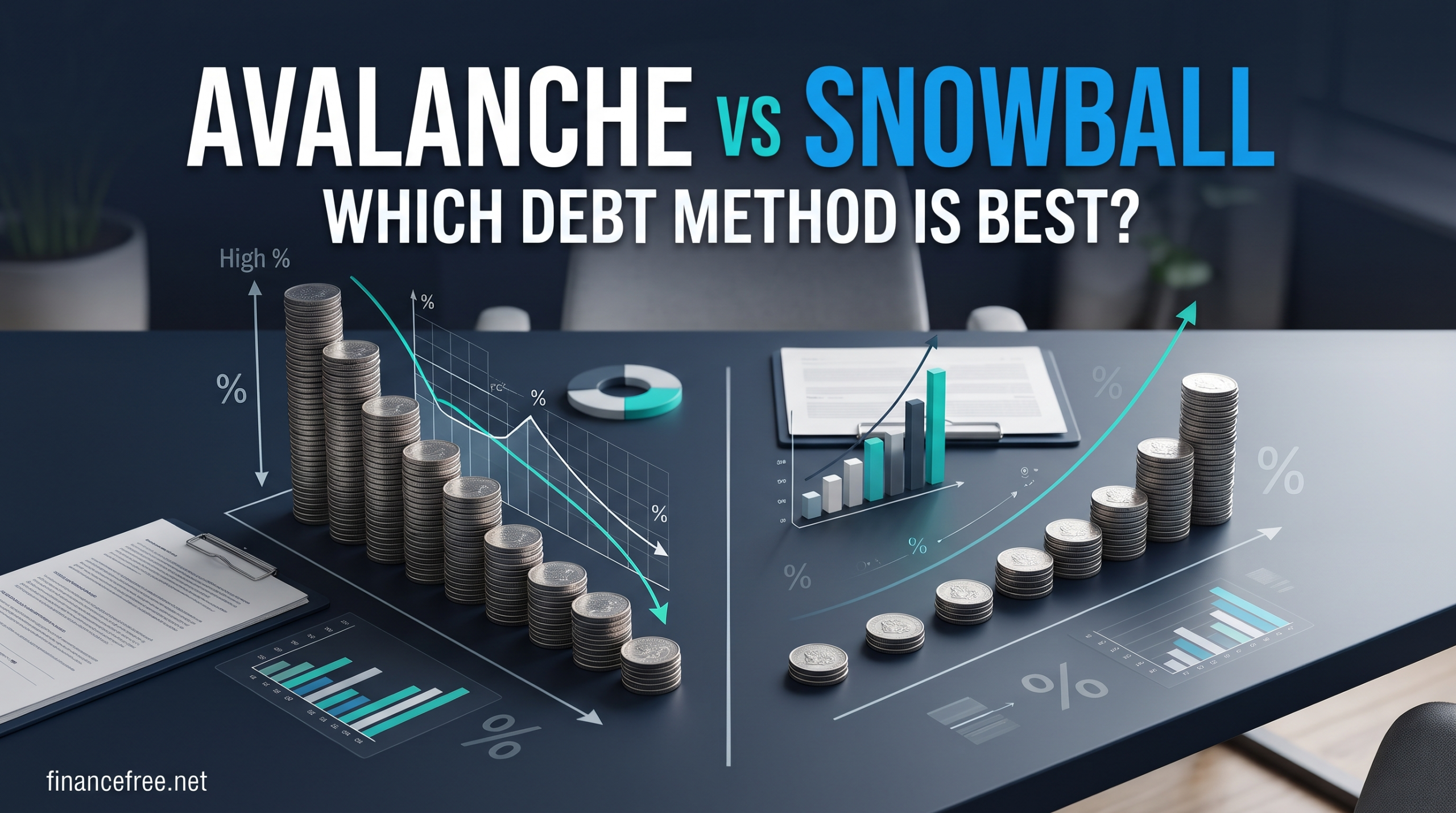
IMAGE-1
This guide compares both methods directly. It covers the four core decision factors you need to evaluate today.
Note on scope: This comparison applies to active debt repayment. It does not cover debt settlement, debt consolidation loans, or bankruptcy proceedings.
In Short
- Debt Avalanche saves the most total money and finishes faster mathematically.
- Debt Snowball generates quick psychological wins by eliminating entire balances quickly.
- Your income stability and personal motivation dictate which strategy will actually succeed.
Understanding the Mechanics
Both strategies require the exact same foundation. You make minimum required payments on every debt account every month.
Then, you direct all extra money toward a single targeted debt. The difference lies strictly in how you choose that target debt.
How the Debt Avalanche Works
With the Debt Avalanche, you order your debts from the highest interest rate to the lowest interest rate.
Your account balances do not matter here. A $20,000 balance at a 24% annual percentage rate (APR) comes before a $1,000 balance at 12% APR.
You direct all excess extra funds toward that 24% APR account. Once that balance hits zero, you roll its entire payment into the next highest APR balance.
This method slashes the total interest accumulating on your debt each day. It keeps more money in your bank account over the long run.
How the Debt Snowball Works
With the Debt Snowball, you order your debts from the smallest total balance to the largest total balance.
Your interest rates do not matter here. A $500 medical bill at 0% interest comes before a $15,000 credit card at 22% interest.
You direct all excess extra funds toward that $500 balance until it is fully wiped out. Wiping out accounts quickly frees up monthly cash flow and creates quick wins.
Once that smallest account is cleared, you roll its minimum payment and your extra funds into the next smallest balance.
Key Takeaways
- Avalanche prioritizes high APRs regardless of balance size.
- Snowball prioritizes low balances regardless of interest rate.
- Both methods use the rollover payment principle to accelerate repayment over time.
The 4 Critical Decision Factors
Deciding between these two strategies requires looking at your specific financial situation. Choose based on these four real-world factors.
Factor 1: The Interest Rate Spread
Look at the difference between your highest interest rate and your lowest interest rate. We call this the interest rate spread.
If your debts range from a 29% store credit card to a 4% personal loan, the spread is massive. The Debt Avalanche will save you thousands of dollars here.
If all your debts have similar interest rates—say, between 17% and 20%—the total interest difference between the two methods will be minimal.
When the interest rate spread is small, the Debt Snowball often wins. You get behavioral benefits without paying a major financial penalty.
Factor 2: Your Need for Behavioral Wins
Personal finance is largely behavioral. Mathematical models assume human beings execute plans perfectly for years without losing motivation.
If you feel overwhelmed by having multiple open debt accounts, you need quick wins. Eliminating two small accounts in ninety days builds powerful momentum.
If seeing monthly account balances drop gives you enough satisfaction to stick with a plan, choose the Debt Avalanche.
The mathematically optimal strategy is useless if you abandon it after six months out of frustration.
Factor 3: Income Stability and Cash Flow Risk
Take a close look at your monthly cash flow reliability. Consider how secure your income is over the next twelve months.
The Debt Snowball reduces required monthly expenses faster. Every time an account balance hits zero, that account’s required minimum payment disappears.
If your income fluctuates, wiping out two small accounts quickly lowers your mandatory monthly overhead. This lowers your risk during lean income months.
If your income is steady, you can comfortably absorb minimum payments while the Avalanche method quietly grinds down high-interest debt.
Factor 4: Total Number of Open Accounts
Managing ten open debt accounts creates high administrative fatigue. You face ten separate due dates, ten statements, and ten chances to miss a payment.
The Debt Snowball excels at eliminating account numbers quickly. Reducing ten open accounts down to four in a short period simplifies your financial life.
If you only hold two or three total accounts, administrative fatigue is low. In that scenario, focus directly on interest rates using the Debt Avalanche.
Bottom Line
- Large interest rate spreads favor the Debt Avalanche.
- High administrative stress and variable income favor the Debt Snowball.
- The best strategy is the one you can stick with until every balance reaches zero.
Practical Comparison Tool
Use this evaluation matrix to score your personal debt situation. Count which column receives more matches based on your current numbers.
| Financial Scenario | Recommended Method | Primary Benefit |
|---|---|---|
| High APR spread (e.g., 28% vs 6%) | Debt Avalanche | Maximum interest savings |
| 5+ small balances under $1,000 | Debt Snowball | Fast reduction of open accounts |
| Variable/Commission income | Debt Snowball | Lowers mandatory monthly bills fast |
| High discipline, fixed income | Debt Avalanche | Fastest theoretical path to zero debt |
Step-by-Step Debt Elimination Protocol
Follow this four-step process to set up your repayment pipeline. Execute these steps in order to avoid critical money mistakes.
Step 1: Audit and List Every Debt
Gather your latest statements for every credit card, personal loan, medical bill, and auto loan. Create a plain table or spreadsheet.
List four exact data points for each debt: account name, total current balance, current APR, and required monthly minimum payment.
Do not include mortgage debt in this operational list. Focus exclusively on consumer debt and high-interest liabilities.
Step 2: Choose Your Primary Focus Account
If choosing Avalanche, sort your table by APR from highest to lowest. Account number one is your target.
If choosing Snowball, sort your table by balance from smallest to largest. Account number one is your target.
Highlight that top target account. This is the only debt that receives extra payments this month.
Step 3: Automate Minimum Payments
Set up automatic monthly minimum payments for every account on your list. This protects your credit score from missed payment flags.
Calculate your remaining baseline extra cash available each month. Direct that exact sum to your single target account as an extra principal payment.
Never split extra cash across multiple accounts. Concentrate all extra payment power onto the single target account to maximize impact.
Step 4: Reassess and Roll Over
When your target account reaches a zero balance, pause and celebrate briefly. Then instantly adjust your payment automation.
Take the entire monthly amount you were paying toward account one (minimum payment plus extra cash). Add it directly to account two’s minimum payment.
Repeat this rollover process for every subsequent account until all balances hit zero.
Quick Summary
- Audit balances and APRs before selecting a strategy.
- Automate minimums on all non-target accounts to prevent late fees.
- Direct 100% of extra funds to a single target account at a time.
Common Pitfalls and How to Avoid Them
Avoid switching strategies midway through your repayment journey. Switching between Snowball and Avalanche every three months destroys momentum.
Pick one methodology and commit to it for at least twelve full months before re-evaluating.
Do not pause debt payments to invest in speculative assets. Paying off a 20% credit card balance delivers a guaranteed 20% return on your capital.
Ensure you keep a small cash buffer—typically $1,000 to $1,500—in a savings account. This prevents you from relying on credit cards when unexpected minor expenses occur.