
Is a High-Yield Savings Account Worth Switching To?
Switching bank accounts feels like a chore. Opening new profiles, linking external accounts, and moving money takes actual time.
Is moving your money to a high-yield savings account (HYSA) worth that effort, or is it just marginal financial noise?
For most people holding cash reserves, the answer comes down to balance size and how quickly you need access to funds.
This guide cuts through the marketing noise to show who actually benefits from switching and who is better off staying put.
The Math Behind the Switch: Real Dollar Differences
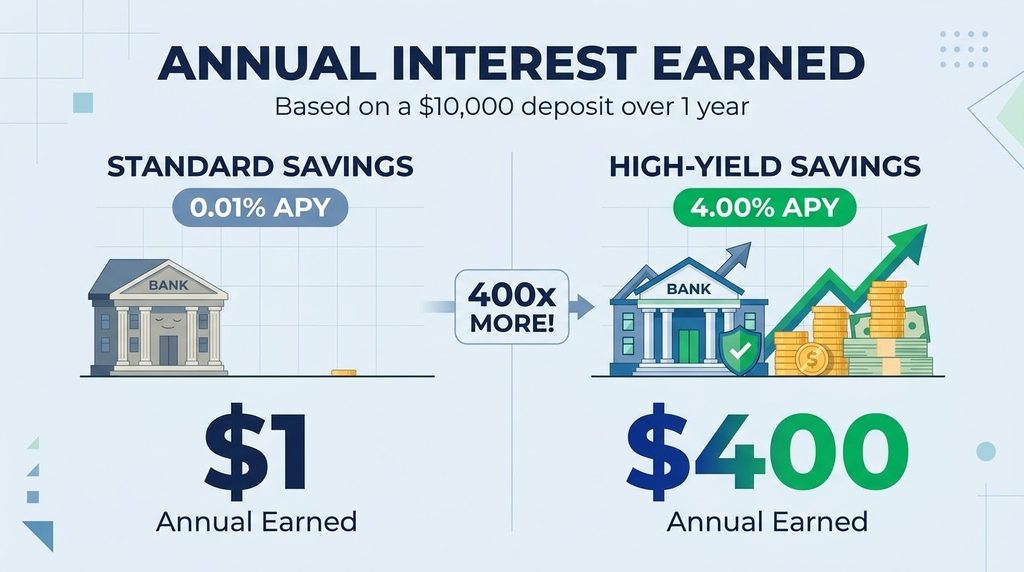
Traditional brick-and-mortar banks frequently pay near-zero interest on standard savings accounts, often lingering around 0.01% APY.
Online high-yield savings accounts regularly offer rates significantly higher because they lack physical branch overhead costs.
The mathematical difference becomes clear when comparing annual cash returns across typical cash balances.
On a $1,000 balance, a 0.01% yield generates ten cents per year. A 4.00% yield generates $40 over twelve months.
On a $10,000 balance, that comparison shifts from $1 per year to $400 in interest for the exact same cash reserve.
For a $25,000 emergency fund, the gap stretches to $1,000 annually in passive earnings with identical capital preservation.
Key Takeaways
- Small balance accounts under $1,000 see modest absolute dollar gains from higher interest yields.
- Emergency funds of $5,000 or more generate meaningful, risk-free annual yield in an HYSA.
- Interest compounds daily or monthly, amplifying real gains over multi-year holding periods.
Who Should Switch (and Who Should Stay Put)
Switching is not universally necessary for every banking customer. Your financial profile dictates whether the move creates real value.
You should switch if you maintain an emergency fund equal to three to six months of expenses.
You should also switch if you are accumulating cash for a medium-term goal, such as a house down payment or wedding.
Conversely, stay put if your total savings balance sits consistently below $1,000.
At lower balances, the administrative effort of managing two banks outweighs the small annual dollar return.
You should also stay put if you rely heavily on physical branch cash deposits, as most online HYSAs do not accept physical currency directly.
Bottom Line
- Switch if holding $3,000 or more in idle cash intended for medium-term use or emergencies.
- Stay put if you frequently deposit physical cash or maintain balances near operational zero.
- Keep checking operations local if immediate face-to-face teller access is critical to your daily workflow.
4 Critical Factors to Check Before Opening an Account
Not all high-yield savings accounts operate on identical terms. Review these key details before signing up.
First, verify FDIC or NCUA deposit insurance coverage. This protects up to $250,000 per depositor if the institution fails.
Second, inspect the fee schedule carefully. Watch for monthly maintenance fees, inactivity charges, or minimum balance thresholds.
A high rate loses its advantage quickly if offset by a $10 monthly account maintenance fee.
Third, understand that HYSA annual percentage yields are variable. Rates fluctuate based on Federal Reserve benchmark decisions.
Fourth, test transaction speed limits. Standard ACH transfers between separate banks generally take one to three business days.
If you require instant transfer capability back to your main checking account, evaluate whether the bank supports same-day transfer networks.
In Short
- Verify FDIC insurance directly on the official federal registry prior to transferring money.
- Prioritize accounts with zero monthly fees and zero minimum balance rules.
- Expect floating interest rates that adjust naturally alongside macroeconomic shifts.
Step-by-Step Guide: How to Switch Without Friction
Follow this systematic process to safely move your savings reserve without disrupting daily cash flow.
- Audit your balance and cash needs: Calculate the exact cash reserve you can move without impacting checking account minimums.
- Verify institution coverage: Confirm the target online bank holds active federal deposit insurance.
- Open and link accounts: Complete identity verification and link your current primary checking account via micro-deposits or instant verification.
- Execute a test transfer: Send a small trial amount ($20 to $50) to verify transfer timing before moving your full cash balance.
- Automate future savings: Set up recurring monthly ACH transfers directly from checking into your new HYSA.
Quick Summary
- Never transfer full balance amounts before confirming account link stability with a small test deposit.
- Maintain a small cushion in checking to avoid unintended overdrafts during settlement windows.
- Automate regular monthly transfers to maintain consistent wealth accumulation habits.