
ClickBank vs Amazon Associates 2026: Which Pays More?


ClickBank vs Amazon Associates 2026 represents the core decision most affiliate marketers face when choosing their primary monetization platform. It’s about matching platform mechanics to how you actually plan to build revenue.
Most comparison articles skip the part where commission rates don’t automatically translate to income. A 70% commission means nothing if conversion rates are 0.5%, while a 4% commission can generate consistent cash flow with 8% conversions and higher traffic volume.
This breakdown explains what each platform does well, where the structural trade-offs exist, and how to decide which aligns with your traffic source, audience trust level, and content strategy. No speculation about future earnings—just the operational differences that determine whether a platform works for your specific setup.
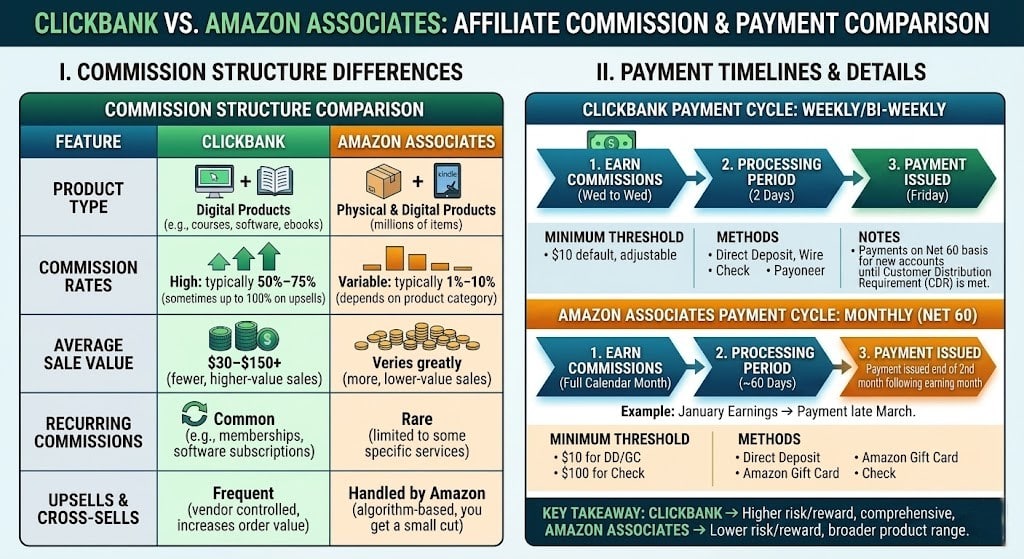
ClickBank vs Amazon Associates 2026: Direct Metrics Comparison
Understanding the Core Platform Difference
ClickBank and Amazon operate under fundamentally different business models, which shapes everything from commission structures to affiliate support systems.
Amazon runs affiliate marketing as a customer acquisition cost. The company’s primary revenue comes from retail sales, not affiliate partnerships. This means commission rates reflect what Amazon considers an acceptable cost per new customer—which tends to be lower than platforms where affiliate success directly drives the business model.
ClickBank exists specifically to connect product creators with affiliates. Vendor success depends entirely on affiliate performance, which creates structural incentives to offer higher commissions and better affiliate support. The platform makes money when affiliates make sales, not from direct retail operations.
Quick Summary
- Amazon treats affiliates as a marketing expense within a larger retail operation
- ClickBank’s entire business model depends on affiliate success
- This structural difference determines commission rates, support quality, and platform flexibility
- Neither model is inherently better—they serve different affiliate strategies
Product Selection: Quantity vs Niche Depth
Amazon lists approximately 12 million products directly and hosts a marketplace exceeding 353 million total products. The selection spans every major retail category, from electronics and home goods to books, clothing, and grocery items.
ClickBank maintains several thousand products specifically structured for affiliate promotion. The catalog focuses heavily on digital products (online courses, software, ebooks) with a growing selection of physical products in health, fitness, and personal development niches.
The quantity advantage clearly favors Amazon. You can build a general lifestyle blog and monetize nearly any product recommendation without worrying about availability.
ClickBank’s strength lies in niche concentration. If your content targets online business education, personal finance training, health optimization, or relationship advice, ClickBank offers multiple high-commission options within those specific verticals. You’re not choosing from millions of products—you’re selecting from 50-200 highly relevant offers.
You can browse ClickBank’s product catalog directly to evaluate offer quality before committing to any promotion.
Key Decision Factor: Amazon works better for broad content sites covering multiple topics. ClickBank performs better when you’ve committed to a specific niche and can build sustained trust around particular product categories.
What This Means
- Amazon enables product diversification across unlimited categories
- ClickBank requires niche focus but offers deeper monetization within that niche
- General content sites naturally align with Amazon’s variety
- Authority sites in specific verticals benefit from ClickBank’s concentrated selection
Commission Structure: The Numbers That Actually Matter
Amazon’s affiliate commission rates range from 1% to 10% depending on product category, with most popular categories falling between 3% and 4%. Some categories like luxury beauty products reach 10%, while grocery items sit at 1%.
ClickBank vendors set their own commission rates, typically ranging from 30% to 75% of the product sale price. Digital products commonly offer 50-70% commissions because there’s no physical inventory cost.
Here’s where simple percentage comparisons break down.
A 4% commission on a $200 electronics purchase generates $8. A 60% commission on a $47 digital course generates $28.20. The ClickBank commission is higher, but you need to compare conversion rates and traffic requirements.
If the Amazon product converts at 8% and the ClickBank product converts at 2%, you’d need to send 100 visitors to Amazon to get 8 sales ($64 total) versus 100 visitors to ClickBank for 2 sales ($56.40 total). The Amazon product generates more revenue despite the lower commission rate.
The Practical Reality: Commission percentage alone doesn’t determine income. You need to multiply commission rate × conversion rate × average sale price to understand actual earnings per visitor.
In Short
- ClickBank offers 30-75% commissions but typically lower conversion rates
- Amazon provides 1-10% commissions but higher conversion rates due to brand trust
- Actual earnings depend on commission % × conversion rate × sale price
- Neither platform automatically generates more revenue—context determines performance
Cookie Duration and Attribution Windows
Amazon uses a 24-hour cookie for standard referrals. If someone clicks your affiliate link but doesn’t purchase within 24 hours, you lose the commission. However, if the visitor adds any item to their cart within those 24 hours, the cookie extends to 90 days for those specific items.
Amazon also offers universal cookie attribution. If you refer someone to buy a laptop and they purchase headphones instead within the 24-hour window, you still earn commission on the headphones.
ClickBank provides a standard 60-day cookie across all marketplace products. If you refer traffic today and the visitor purchases within 60 days, you receive credit. Some vendors enable lifetime commissions, meaning you earn on all future purchases from that customer indefinitely.
The cookie length advantage appears to favor ClickBank, but real-world performance is more nuanced. Amazon’s shorter cookie matters less when conversion happens immediately, which occurs frequently given Amazon’s checkout optimization and existing customer accounts.
ClickBank’s 60-day window helps with higher-consideration purchases where people research before buying. Digital courses, business training programs, and premium supplements often involve multi-day decision processes where the extended cookie captures sales that would otherwise be lost.
Bottom Line
- Amazon’s 24-hour cookie works well for impulse purchases and immediate needs
- ClickBank’s 60-day cookie captures consideration purchases and research-based decisions
- Amazon’s cart extension to 90 days protects commissions on delayed purchases
- Cookie length matters most when purchase decisions extend beyond 24 hours
Payment Terms and Processing Speed
ClickBank requires 5 total sales across 3 different payment methods before your first payout. The minimum payout threshold is $10. Payments are processed weekly or biweekly every Wednesday.
ClickBank currently holds a reserve allowance to cover potential chargebacks and refunds, based on historical product data. This means your full commission isn’t immediately available—a portion is held temporarily as protection against returns.
Amazon pays approximately 60 days after a product ships, presumably to account for the return window and chargeback period. The minimum payout is $10 for direct deposit or $100 for check payment.
The payment timing advantage goes to ClickBank for speed but comes with the reserve allowance trade-off. Amazon’s 60-day delay is longer but delivers the full commission amount without withholding.
For new affiliates, the initial payout requirement (5 sales across 3 payment methods) on ClickBank can take longer to reach than Amazon’s straightforward 60-day schedule. Once established, ClickBank’s weekly payments provide faster cash flow.
Key Takeaways
- ClickBank pays faster (weekly/biweekly) but holds a reserve allowance
- Amazon pays slower (60 days) but releases full commission amounts
- New affiliates may receive first Amazon payment before first ClickBank payment
- Established affiliates generally prefer ClickBank’s faster payment schedule
Conversion Rate Dynamics: Trust vs Targeting
Amazon benefits from universal brand recognition and pre-existing customer accounts. Most U.S. internet users already have an Amazon account with saved payment information and shipping addresses. This familiarity typically produces conversion rates between 5% and 12% depending on the product category and traffic source.
ClickBank products require visitors to create new accounts or check out as guests. The vendor brand is often unfamiliar, and the purchase process includes more friction. Typical conversion rates range from 1% to 4%, though well-optimized sales pages in proven niches can reach 5-8%.
The conversion rate gap exists because Amazon has spent decades building checkout optimization and consumer trust. ClickBank vendors vary widely in sales page quality, offer strength, and brand recognition.
Here’s what changes the math: targeted traffic to highly relevant ClickBank offers can outperform general traffic to Amazon products. If you’re sending visitors who specifically need a solution to a defined problem, and the ClickBank product directly addresses that problem, conversion rates can match or exceed Amazon despite the brand recognition gap.
Amazon works better with broad traffic sources where you don’t know exactly what people want to buy. ClickBank performs better with specific traffic where you’ve already identified the core need or problem.
What This Means
- Amazon converts better with cold traffic and general product interest
- ClickBank converts better with warm traffic seeking specific solutions
- Brand recognition gives Amazon a structural conversion advantage
- Targeted traffic and relevant offers can close the conversion gap for ClickBank
Platform Restrictions and Promotional Flexibility
Amazon places significant restrictions on how affiliates can promote products. You cannot use affiliate links in email marketing. Paid search advertising with your affiliate link is prohibited. All product images must be sourced through Amazon’s official API.
These restrictions exist to protect Amazon’s brand and prevent aggressive promotional tactics that might damage customer trust. In practice, this means Amazon affiliates primarily rely on content websites, SEO traffic, and organic social media sharing.
ClickBank allows considerably more promotional flexibility. You can use affiliate links in email marketing (subject to vendor-specific terms). Paid advertising to landing pages and sales letters is permitted. Email list promotion is a common and accepted strategy.
Individual ClickBank vendors may impose additional restrictions, but the platform itself supports diverse promotional methods including PPC campaigns, email sequences, and bonus stacking.
The flexibility difference matters most when you already have an audience. If you’ve built an email list, YouTube channel, or social media following, ClickBank’s promotional options let you monetize that audience directly. Amazon requires you to drive traffic to content first, then to product pages.
In Short
- Amazon restricts email marketing, paid ads with affiliate links, and image usage
- ClickBank permits email promotion, paid advertising, and flexible marketing approaches
- Amazon’s restrictions favor content-based SEO strategies
- ClickBank’s flexibility benefits affiliates with existing audiences
Affiliate Support and Account Management
Amazon operates affiliate support primarily through documentation, FAQs, and standard customer service tickets. The program is largely self-service. Commission changes can occur without individual affiliate notification beyond policy updates.
In April 2020, Amazon reduced commission rates across multiple categories during the COVID pandemic, dropping grocery commissions from 5% to 1% with minimal advance notice. Affiliates had no recourse or negotiation option.
ClickBank provides dedicated account management for Platinum-level affiliates (typically those generating $25,000+ in monthly commissions). Standard affiliates access support through tickets and documentation, but the platform maintains an affiliate-first orientation given the business model alignment.
Commission rates on ClickBank are set by individual vendors, not the platform. While vendors can change rates, they typically avoid this because it would alienate their affiliate base and reduce promotional activity.
The practical difference: Amazon treats affiliates as replaceable traffic sources within a larger retail operation. ClickBank treats high-performing affiliates as critical business partners because the platform’s revenue depends on their success.
Quick Summary
- Amazon offers self-service support and can change commission rates unilaterally
- ClickBank provides account management for top affiliates and maintains stable vendor relationships
- Platform incentives favor affiliates more strongly on ClickBank
- Amazon’s size means individual affiliates have minimal negotiating leverage
When to Use Amazon Associates
Amazon works best in specific scenarios where its structural advantages align with your content strategy and traffic characteristics.
Ideal Amazon Use Cases: You’re building a broad content site covering multiple product categories Your traffic is primarily SEO-based from informational search queries You haven’t yet identified your audience’s primary purchasing intent You want to monetize product mentions without committing to specific vendors Your content naturally reviews, compares, or recommends physical products
Amazon serves as a low-commitment monetization layer for content that would exist regardless of affiliate revenue. If you’re writing genuine product reviews, buying guides, or comparison content, Amazon lets you capture purchase intent without requiring deep vendor relationships or promotional commitments.
The 24-hour cookie duration matters less when you’re capturing immediate purchase intent from people already shopping. Someone reading “best budget laptops under $500” is often ready to buy that day.
Amazon also provides downside protection. If you recommend a product and the vendor discontinues it, Amazon’s vast catalog means visitors can find alternatives without your link breaking. Your content ages better.
Critical Limitation: Amazon alone cannot typically support a full-time income unless you’re generating substantial traffic (usually 100,000+ monthly visitors for most niches). The commission rates require volume.
Bottom Line
- Use Amazon for broad content monetization without vendor dependency
- Best suited for SEO traffic from commercial intent keywords
- Requires high traffic volume to generate significant income
- Works well as supplementary revenue alongside other monetization methods
When to Use ClickBank
ClickBank performs best when you’ve committed to a specific niche and built audience trust that supports higher-ticket offers.
Ideal ClickBank Use Cases: You’ve established authority in a specific vertical (business, health, personal finance) You maintain an email list or social media audience Your traffic comes from warm sources where you’ve built trust You’re comfortable promoting specific products you’ve personally vetted You want to monetize lower traffic volume with higher per-visitor value
ClickBank’s economics work better with smaller, more engaged audiences. Sending 5,000 monthly visitors to targeted ClickBank offers can generate more revenue than sending 50,000 visitors to Amazon products, assuming the offers align well with audience needs.
The platform particularly suits content strategies built around solving specific problems. Online business training, relationship advice, health optimization, and personal development all involve clear pain points where targeted solutions command premium pricing.
Email marketing capability is crucial. ClickBank’s permission to use affiliate links in emails means you can build a list, provide consistent value, and promote relevant offers when they genuinely serve your audience. This relationship-based approach converts better than cold traffic to sales pages.
Critical Requirement: ClickBank requires more upfront product vetting. You’re recommending specific vendors, not a universal marketplace. Choose poorly and you damage audience trust. Choose well and higher commissions reward the additional diligence.
What This Means
- Use ClickBank when you’ve defined your niche and built audience trust
- Best suited for warm traffic from email lists, YouTube channels, or engaged communities
- Can generate meaningful income with lower traffic volume
- Requires careful product selection and vendor relationship management
The Hybrid Approach: Using Both Platforms Strategically
Most successful affiliates don’t choose between ClickBank and Amazon—they use each platform for what it does best.
A practical hybrid strategy might look like this:
Build an authority site in a specific niche (personal finance, home fitness, online business). Use Amazon affiliate links for tool recommendations, equipment reviews, and physical product mentions throughout your content. This captures immediate purchase intent without requiring aggressive promotion.
Simultaneously promote 2-3 carefully selected ClickBank products that solve your audience’s core problems. Use email marketing, dedicated reviews, and educational content to build trust in these specific solutions. This generates higher per-sale revenue from engaged segments of your audience.
The Amazon layer provides consistent baseline revenue from people already shopping. The ClickBank layer captures higher-value conversions from people seeking comprehensive solutions to specific problems.
This approach diversifies income sources while playing to each platform’s strengths. Amazon handles broad product discovery and impulse purchases. ClickBank monetizes deeper audience relationships and problem-solution fit.
Practical Implementation Example: A personal finance blog might use Amazon links for book recommendations, budgeting tools, and financial software mentions. The same site could promote a ClickBank course on real estate investing or tax optimization to readers who’ve demonstrated serious interest through email engagement and content consumption patterns.
In Short
- Amazon provides baseline monetization across all content
- ClickBank captures higher-value conversions from engaged audience segments
- Using both platforms reduces dependency on any single income source
- Match each platform to the appropriate traffic temperature and purchase intent
Realistic Income Expectations and Timeline
Most affiliate marketing content overpromises on income potential and underprepares people for the actual timeline required to generate meaningful revenue.
Amazon Associates typically requires 6-12 months of consistent content creation to reach $500-1,000 monthly revenue. Reaching $3,000-5,000 monthly usually takes 18-24 months and substantial traffic growth. These timelines assume consistent effort, quality content, and reasonable SEO execution.
ClickBank can produce faster initial results if you have an existing audience or paid traffic budget. However, building the audience trust required to convert high-ticket offers typically requires 6-18 months of consistent value delivery before promotional efforts generate sustainable revenue.
Neither platform offers a shortcut to fast income. Both require understanding your audience, creating genuinely helpful content, and building trust before monetization performs at scale.
The path to $10,000+ monthly affiliate income usually involves: 12-24 months of audience building through content or community development Testing multiple offers to identify what converts well with your specific audience Diversifying across both platforms plus potentially other affiliate networks Reinvesting early earnings into content improvement or traffic acquisition
Starting affiliate marketing specifically to make quick money almost always underperforms. Building a content asset or audience first, then monetizing that asset strategically, produces better long-term results.
Key Takeaways
- Expect 6-12 months before either platform generates $500+ monthly revenue
- Meaningful income ($3,000-5,000+) typically requires 18-24 months of sustained effort
- Fast results require existing audiences or paid traffic budgets
- Neither platform replaces the need for audience trust and content quality
All affiliate promotions must comply with FTC affiliate disclosure requirements regardless of which platform you choose.
Decision Framework: Which Platform Matches Your Situation
Rather than choosing the “best” platform, match platform characteristics to your current resources and strategy.
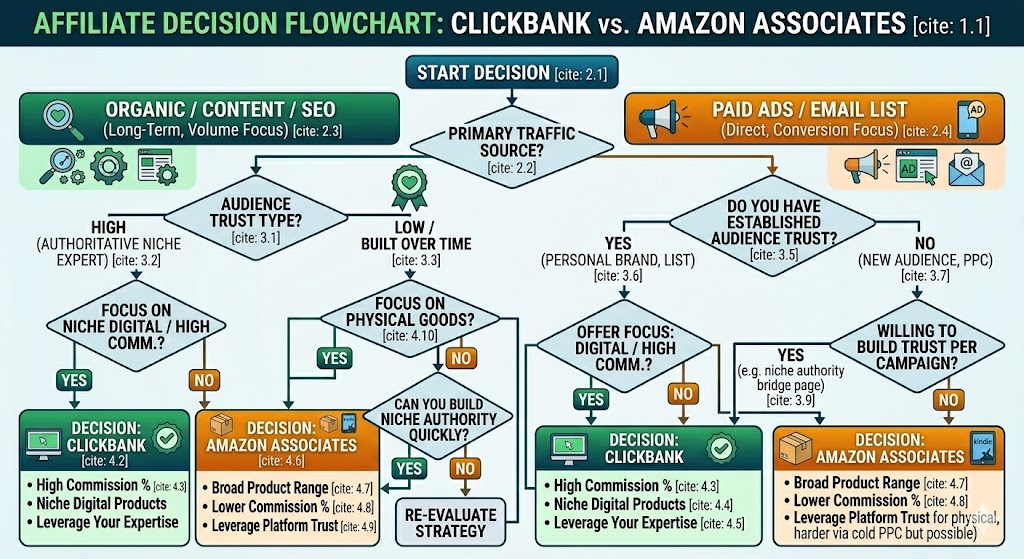
Choose Amazon Associates if: You’re building a content site covering multiple topics or product categories Your primary traffic source is SEO from informational and commercial keywords You want low-commitment monetization without vendor relationship management You’re comfortable with lower commissions in exchange for higher conversion rates You don’t currently have an email list or engaged social media following
Choose ClickBank if: You’ve committed to a specific niche and understand your audience’s core problems You maintain an email list or engaged community where you’ve built trust You’re willing to carefully vet products before promoting them You prefer higher per-sale revenue over volume-based income You have paid traffic capabilities or warm traffic sources
Use both platforms if: You want to diversify income sources and reduce platform dependency Your content naturally includes both broad product mentions and specific solution recommendations You’re building long-term audience relationships where different monetization approaches serve different segments You have the bandwidth to manage multiple affiliate relationships
The question isn’t which platform is superior—it’s which platform mechanics align with how you actually build traffic and audience trust.
What the Comparison Misses: The Effort Behind the Numbers
Affiliate marketing comparisons typically focus on commission rates, cookie duration, and conversion percentages. What they often skip is the operational effort required to make either platform work.
Amazon monetization primarily requires content creation at volume. You need substantial published content to capture enough search traffic for Amazon’s lower commission rates to compound into meaningful income. The work is in research, writing, and SEO optimization.
ClickBank monetization requires deeper audience development. You need to build trust through consistent value delivery before promotional efforts convert well. The work is in relationship building, email marketing, and strategic product selection.
Neither approach is easier—they require different types of sustained effort. Content creation is time-intensive but relatively straightforward. Audience building is relationship-intensive and requires patience.
Most affiliates underestimate the timeline for both approaches. Amazon doesn’t generate significant income from minimal content. ClickBank doesn’t convert cold traffic without trust-building infrastructure.
The best platform is the one where you’re willing to do the actual work required, not the one with theoretically better numbers.
Bottom Line
- Amazon requires high content volume and SEO execution
- ClickBank requires audience trust and relationship development
- Both platforms demand sustained effort over 12-24+ months
- Choose based on which type of work you’re actually willing to do consistently

