
Amazon FBA Fees Explained: Complete Cost Breakdown for 2026

Amazon FBA fees 2026 are more complex than most sellers realize, and you’re probably paying more than you think.
Most sellers know the money’s going out. They just don’t know exactly where it’s going, why it changes month to month, or how to build accurate profit projections around it.
Amazon hasn’t made this easier. The fee structure keeps evolving, and the math behind it keeps getting more layered.
This guide breaks down every category of Amazon FBA fees as they stand in 2026. You’ll learn what drives each cost, how recent changes affect your margins, and how to plan around fees instead of just reacting to them.
What Amazon FBA Fees Actually Cover
Amazon FBA fees pay for the entire back-end logistics operation once your inventory arrives at their warehouse.
That includes storage space, picking your product when it sells, packing it into a shipping box, shipping it to the customer, handling routine customer service inquiries, and processing returns in most categories.
The confusion doesn’t come from any single fee being complicated. It comes from how different fees interact with each other and how the same product can end up costing vastly different amounts depending on timing, inventory levels, or packaging decisions you made months earlier.
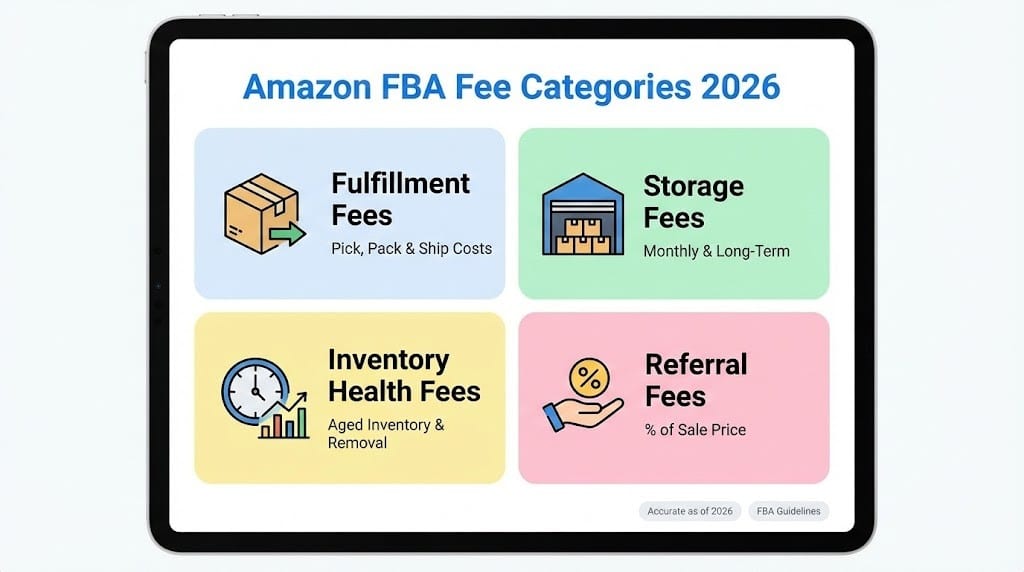
FBA fees generally break into four main buckets: fulfillment fees per unit sold, monthly storage fees, inventory health-related penalties, and optional service fees for specific programs.
Let’s walk through each one.
Quick Summary
- FBA fees cover warehousing, picking, packing, shipping, customer service, and returns
- Costs vary based on timing, inventory behavior, and product dimensions
- Fee complexity comes from how different charges interact, not individual line items
Fulfillment Fees: The Per-Unit Cost of Every Sale
Every time you sell a product through FBA, Amazon charges a fulfillment fee.
This single charge bundles everything: picking the item off the shelf, packing it, shipping it to the customer, handling standard customer service, and processing returns in eligible categories.
How Fulfillment Fees Are Calculated
Fulfillment fees depend on three factors: size tier, shipping weight, and dimensional weight.
Size tier is determined by the physical dimensions of your product after it’s packaged. Amazon groups products into categories like small standard, large standard, small oversize, and so on.
Shipping weight is the actual weight of the product plus packaging.
Dimensional weight measures how much space the package takes up. This is where sellers get surprised. A lightweight but bulky item can cost significantly more to fulfill than a heavier but compact item because it takes up more room in the truck.
Amazon’s rate card updates periodically, but the core logic stays consistent. Small, dense products cost less. Large or awkwardly shaped products cost more.
The Packaging Trap Most Sellers Fall Into
Here’s the mistake that quietly erodes margins: poor packaging efficiency.
If your product’s dimensions push it even slightly into the next size tier, your per-unit fulfillment fee can jump by dollars, not cents.
And Amazon doesn’t measure based on the manufacturer’s box. They measure after any prep work done at the fulfillment center, which can add padding, protective materials, or outer boxes.
A product that’s 17.9 inches long stays in one tier. The same product at 18.1 inches jumps to the next tier and costs substantially more per unit.
Measure carefully. Assume Amazon will add prep materials. Build in a margin of error when forecasting costs.
Key Takeaways
- Fulfillment fees are charged per unit and cover the full logistics chain
- Dimensional weight (space used) often matters more than actual weight
- Small packaging changes can push products into higher fee tiers and destroy margins
Storage Fees: The Monthly Cost of Sitting Inventory
Amazon charges storage fees every month based on how much space your inventory occupies in their warehouses.
The rate is calculated per cubic foot, but it’s not a flat rate year-round.
Standard vs. Peak Season Storage Rates
For most of the year, Amazon charges standard storage rates.
From October through December, they switch to peak season rates, which are significantly higher. This reflects the increased demand for warehouse space during the holiday shopping period.
Peak season rates apply to all inventory in Amazon’s system during Q4, whether or not it actually sells during that window.
If you’re holding slow-moving inventory through the holidays, you’re paying premium storage rates on products that aren’t generating revenue.
Aged Inventory Surcharges: The New Penalty System
Amazon used to charge long-term storage fees twice a year for inventory sitting unsold beyond six months.
They’ve replaced that with aged inventory surcharges, which kick in faster and apply more frequently.
Now, if your inventory sits unsold past certain thresholds (typically 181 days, 210 days, and beyond), you start paying escalating surcharges on top of regular storage fees.
This creates a compounding problem. Slow-moving inventory isn’t just tying up your capital. It’s actively costing you more every month it sits there.
For 2026, this is the fee category sellers need to watch most closely. What used to be a cash flow issue is now a margin erosion issue.
Amazon Warehousing and Distribution (AWD) as a Buffer
If you don’t have your own warehouse or third-party logistics partner, Amazon offers a service called Amazon Warehousing and Distribution.
AWD lets you store bulk inventory upstream from FBA fulfillment centers at lower rates. You then send smaller batches into FBA as needed, which can help you avoid aged inventory surcharges while maintaining stock availability.
It’s not a perfect solution for everyone, but it’s worth evaluating if storage fees are eating into your margins.
Bottom Line
- Storage fees are charged monthly per cubic foot and vary by season
- Q4 peak rates are significantly higher than standard rates
- Aged inventory surcharges now penalize slow-moving stock more aggressively than the old system
- AWD can help reduce long-term storage costs if you lack your own warehousing
Inventory Health Fees: The Hidden Costs of Poor Planning
This is where most “mystery fees” show up on seller statements.
Amazon has increasingly used fees as behavioral incentives, penalizing inefficiency that clogs their fulfillment network or creates logistical problems.
Low Inventory Level Fees
This one catches sellers off guard because it seems counterintuitive.
If your inventory levels consistently run too low to meet expected demand, Amazon now charges a fee.
Why? Because it forces them to ship products inefficiently across their network to maintain Prime delivery promises. Instead of shipping from the nearest fulfillment center, they might have to ship from across the country, which costs them more.
That cost now gets passed to you.
So you’re penalized for having too much inventory (storage fees) and for having too little inventory (low inventory fees). The target is consistent, predictable stock levels that match your actual sales velocity.
Removal and Disposal Fees
Getting inventory out of Amazon’s system isn’t free.
If you need to remove unsold inventory to avoid aged inventory surcharges, Amazon charges a per-unit removal fee. Oversized items cost more to remove than standard-sized items.
You can also choose disposal, where Amazon destroys the inventory for you. This costs less than removal but means you recover nothing.
A third option is liquidation, where Amazon sells your product at steep discounts (often pennies on the dollar) and sends you whatever they recover. It’s better than paying for disposal, but it’s not a real exit strategy.
Returns Processing Fees
General returns handling is built into the fulfillment fee, but Amazon charges additional returns processing fees in high-return categories like apparel.
They also charge these fees if your product has an abnormally high return rate compared to similar items in your category.
This fee structure incentivizes sellers to improve product quality, packaging, and listing accuracy to reduce return rates.
In Short
- Low inventory fees penalize running out of stock too often
- Removal and disposal fees apply when you pull inventory out of FBA
- Returns processing fees hit high-return categories and products with above-average return rates
- These fees are designed to shape seller behavior, not just cover costs
Referral Fees: The Cost Amazon Takes From Every Sale
Technically, referral fees aren’t FBA fees. You pay them whether you use FBA or fulfill orders yourself.
But they’re critical to any realistic profit calculation, so we’re including them here.
How Referral Fees Work
Amazon charges a referral fee as a percentage of your total sale price (including the item price plus any shipping or gift wrap charges you collect).
The percentage varies by category. Most products fall between 8% and 15%, though some categories like Amazon device accessories go higher.
For many products, the referral fee is actually larger than the FBA fulfillment fee.
If you’re calculating margins and only accounting for FBA fees without including the referral fee, your projections will be dangerously optimistic.
What This Means
- Referral fees are charged as a percentage of total sale price
- Rates typically range from 8% to 15% depending on category
- Referral fees often exceed FBA fulfillment fees and must be included in margin calculations
How Amazon FBA Fees 2026 Have Evolved: What Changed
Individual fee amounts change every year, but the strategic direction has been consistent.
Amazon is increasingly tying fees to inventory behavior and velocity.
Penalties for Inefficiency Are More Explicit
You now face explicit penalties for having too much inventory (storage fees and aged inventory surcharges) and for having too little inventory (low inventory fees).
The entire system is designed to reward accurate demand forecasting and consistent inventory turnover.
Fulfillment Centers Are Distribution Nodes, Not Warehouses
Amazon’s message is clear: their fulfillment centers are meant for rapid throughput, not long-term storage.
If you need to hold buffer stock for longer periods, you’re expected to use your own warehouse, a third-party logistics provider, or Amazon’s upstream AWD service.
Treating FBA as cheap long-term storage will cost you significantly more in 2026 than it did a few years ago.
Key Takeaways
- Amazon’s fee evolution emphasizes inventory velocity over static storage
- Penalties for both overstocking and understocking are now explicit
- The system rewards accurate forecasting and rapid inventory turnover
How to Plan for Amazon FBA Fees in 2026
Instead of trying to minimize every individual fee, focus on controlling your exposure to fee variability.
Treat Inventory Age as a Financial Metric
Track how long inventory sits before it sells, not just whether it eventually sells.
Align your reorder timing with realistic sell-through rates based on actual historical data, not optimistic projections.
Over-ordering to hit a supplier’s price break often gets negated by three months of aged inventory surcharges. Run the math before committing to bulk orders.
Build Defensive Pricing Models
Don’t price your products assuming best-case scenario fees.
Build your landed cost models assuming peak storage rates, average return rates for your category, and standard fulfillment fees at the higher end of your potential size tier.
If your margins hold under those assumptions, you’re protected when fees fluctuate or when seasonal timing doesn’t work in your favor.
If your margins don’t hold under conservative assumptions, you’re selling a product with structural profitability problems that fee optimization can’t fix.
Evaluate Hybrid Logistics Strategies
For many sellers, FBA is no longer the only answer for every SKU.
Slower-moving products might be more profitable fulfilled through a third-party logistics provider (3PL) that charges flat monthly rates instead of velocity-based penalties.
High-volume products might benefit from using AWD for bulk storage and sending smaller batches into FBA as needed.
The best logistics strategy in 2026 is often a hybrid approach where you match each product’s characteristics to the most cost-effective fulfillment method.
Bottom Line
- Track inventory age as aggressively as you track sales velocity
- Price products assuming peak fees and average returns, not best-case scenarios
- Consider hybrid logistics approaches instead of defaulting to FBA for every product
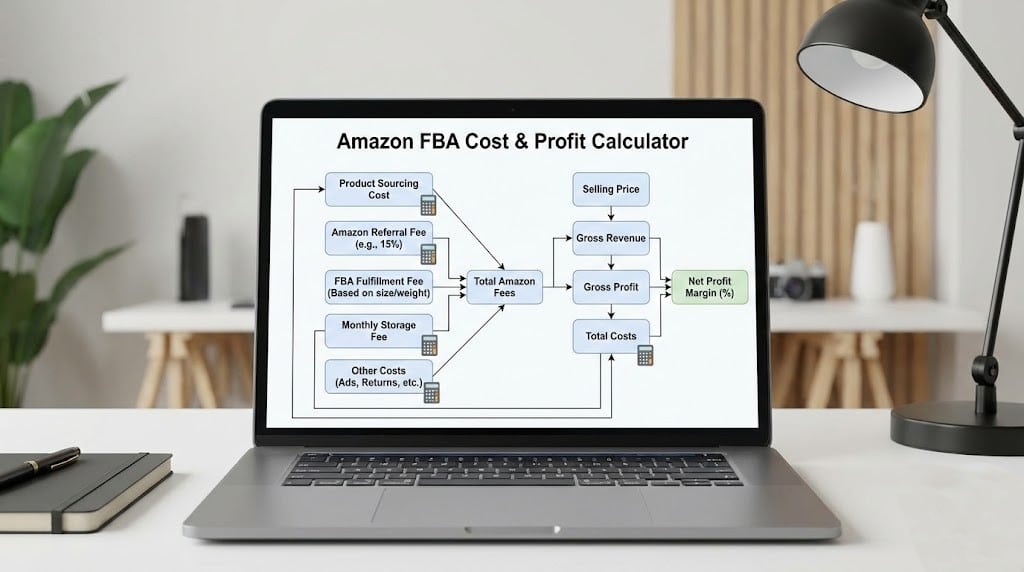
Step-by-Step Fee Planning Framework
Here’s a practical framework for evaluating FBA profitability on any product:
Step 1: Calculate Total Landed Cost Add product cost + shipping to Amazon + prep costs if applicable.
Step 2: Estimate Worst-Case Fulfillment Fee Use Amazon’s fee calculator, but assume your product measures at the high end of its dimensions. Add 5% buffer for packaging materials Amazon might add.
Step 3: Add Peak Storage Costs Assume your inventory will sit for at least one month during Q4. Calculate storage fees at peak rates, not standard rates.
Step 4: Include Referral Fee Multiply your intended sale price by your category’s referral fee percentage.
Step 5: Add Return Assumptions If you’re in apparel or another high-return category, assume 10-15% of sales will incur return processing fees.
Step 6: Calculate Break-Even and Target Margins Your sale price must cover all the above plus leave room for advertising, discounts, and profit.
If your target margin is below 20% after all fees, you’re operating with very little buffer for fee increases, slower sales velocity, or competitive pricing pressure.
Quick Summary
- Build fee assumptions into pricing before launching products, not after
- Use peak rates and worst-case dimensions when forecasting costs
- Target 20%+ margins after all fees to protect against variability
Final Takeaway
Amazon FBA fees are no longer just a static cost of doing business.
They’re a dynamic behavioral system designed to maximize Amazon’s network efficiency and penalize sellers who create logistical inefficiency.
Sellers who understand how fees respond to inventory decisions can protect margins and avoid surprises.
Sellers who ignore the nuances often discover profitability problems only after margins have already eroded.
Treat fees as a planning variable, not just an expense line. Build conservative assumptions into your pricing. Track inventory age as aggressively as sales velocity.
And recognize that for many products in 2026, the best logistics strategy isn’t “always use FBA.” It’s “use the right fulfillment method for each product’s specific characteristics.”
